
Color & Mood—The Language of Warm Floors
The Feeling Beneath Your Feet
There's a reason you feel instantly at home in a room with warm floors. Before the furniture arranges itself in your mind, before you've taken in the art on the walls, the floor has already spoken. It says: come in, stay, settle. This isn't coincidence. It's color psychology doing exactly what it was designed to do.
Warm-toned floors—those grounded in brown, amber, terracotta, and rose—carry the most primal associations in our visual vocabulary: earth, bark, refuge, nest, harvest. These are the colors of shelter, of warmth gathered beneath your feet. Whether that floor is wood, tile, or a warm-toned terrazzo and resinous flake blend, the effect starts the same way—from the ground up.
When you choose a warm blend for your floor, you're not simply selecting a color. You're choosing how that space will feel.
Color Psychology: The Science of Warmth
Brown is among the most psychologically stabilizing colors we know. It signals rootedness, reliability, and quiet permanence—the same qualities we associate with old-growth wood, worn stone, and the texture of soil after rain. Red and amber undertones introduce energy into that foundation: they advance visually, making a space feel more present, more inhabited.
Studies in environmental psychology show that warm-toned environments register as physically warmer than identical spaces with cool palettes. When that effect starts at the floor, it suffuses the entire room. The result is a space that doesn't just look warm—it feels it, from the first step in.


The Light Factor: Natural & Artificial
Warm-toned floors behave beautifully in natural light—especially the golden-hour tones of morning and late afternoon, when sunlight enters at an angle and brings out the amber, copper, and honey notes in a blend. This is especially true of warm terrazzo and resinous flake floors, where light interacts with the texture and reflectivity of the aggregate itself. These floors deepen and glow rather than flatten.
Under artificial light, bulb temperature matters enormously. Warm white bulbs (2700–3000K) amplify the richness of a warm blend, lending it a candlelit quality that feels genuinely inviting. Cooler daylight bulbs (5000K+) will mute the warmth slightly, pulling out the neutral undertones—which can be used deliberately to balance the palette of a warmer space.
North-facing rooms, which receive cool indirect light throughout the day, benefit most from warm-toned floors. The blend compensates for the room's natural coolness, creating equilibrium rather than contrast.

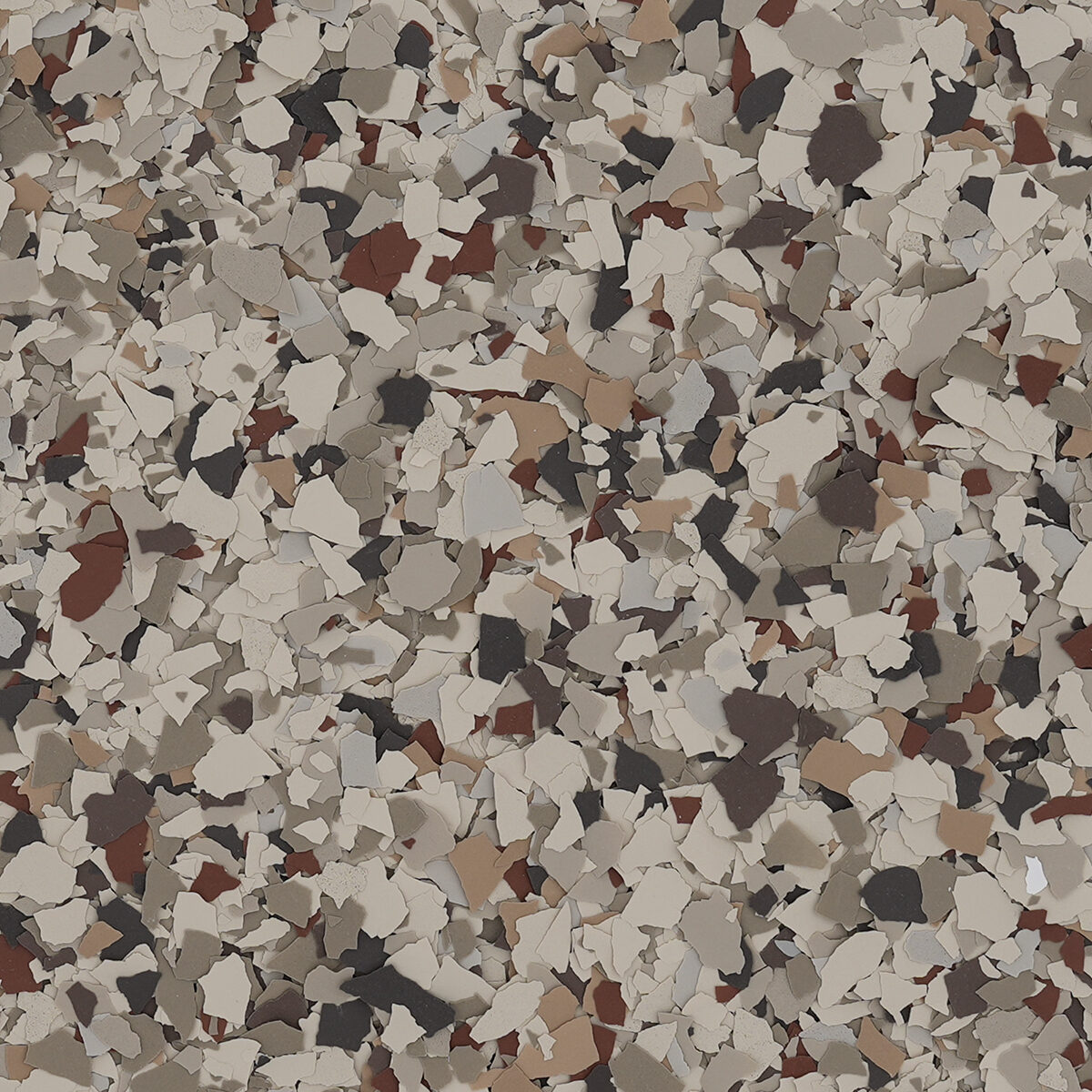
Cottage (UVFB-1006) under natural light

Cascade (FB-4207) under artificial light
Reading the Space: Warm Tones in the Real World
Torginol floors live in some of the most demanding environments imaginable—and warm-toned terrazzo and resinous flake blends rise to meet every one of them. In residential garages and rec rooms, a warm floor transforms a purely functional space into something that feels inhabited, an extension of the home rather than an afterthought. In restaurants, color psychology and appetite are inseparable: warm tones have long been shown to stimulate engagement and encourage guests to settle in, making them a natural choice for any dining environment that depends on atmosphere as much as cuisine.
In healthcare settings, where the goal is to reduce anxiety and soften the clinical edge of a space, warm blends do quiet, meaningful work—floors that feel human rather than institutional. In transportation hubs, where people move through spaces under stress and uncertainty, warmth at the floor level provides a grounding that the rest of the environment often cannot. In manufacturing facilities, commercial kitchens, and auto repair spaces, warm tones define zones, signal purpose, and give hardworking environments a sense of consideration that improves both morale and the experience of everyone who works there.
In each of these spaces—from the garage to the restaurant to the operating corridor—a warm Torginol floor does something no wall color or ceiling fixture can quite replicate. It grounds the experience from the very bottom up.

Airport Terminal

Commercial Kitchen

Healthcare Space
A Designer's Perspective: Warm Tones & Current Trends
The return to warmth in interior design is a moment worth celebrating—a collective reach toward comfort, softness, and spaces that feel genuinely human. After years of cool gray dominance, the design world has shifted decisively toward texture, earthiness, and the kind of comfort that feels earned. Terracotta, adobe, warm stoneware, and natural fibers are all signals of the same impulse: spaces that feel like somewhere, not just something.
This isn't just our read of the room. NCS Colour's “Colours Beyond 2027+” forecast, developed with its international Forecast Council, names “Dark”—deeper, muted hues that carry material weight and create tactile, grounding atmospheres—as one of three defining color directions ahead, right alongside our own instinct toward warmth and earthiness.
A warm-toned terrazzo or resinous flake floor is the most efficient way to participate in this shift. Paired with white or warm-white walls, the blend anchors without overwhelming. Layered with natural textiles—linen, wool, undyed cotton—it creates depth that reads as deliberately curated. Against darker cabinetry or rich wood tones, it creates the kind of tonal warmth that is increasingly defining premium residential design.
Brown, amber, terracotta, and rose—grounding, earthy tones built to live on. The Torginol floors that feel right from day one.




Frequently Asked Questions
What color floor makes a room feel warmer?
Floors in the brown, amber, terracotta, and rose family read as warmer because they echo natural materials like wood, clay, and soil. Warm-toned terrazzo and resinous flake blends bring that same effect to high-traffic and commercial spaces.
Do warm-toned floors work in north-facing rooms?
Yes—north-facing rooms receive cool, indirect light throughout the day, and a warm-toned floor compensates for that coolness, creating balance rather than contrast.
What's the difference between warm and cool flooring tones?
Warm tones (browns, ambers, terracottas, roses) visually advance and read as inviting and grounded. Cool tones (grays, blues) recede and read as clean or clinical. The choice changes how a space feels, not just how it looks.
Are warm-toned terrazzo and resinous flake blends suitable for commercial spaces?
Yes. Warm blends are used across restaurants, healthcare facilities, transportation hubs, manufacturing floors, and commercial kitchens, where they soften institutional environments and support the mood of the space.
Explore the full Torginol blend library and find the mood that fits your space at torginol.com